HOME
Chapter One: Past Practice in Brief Implied agreements, also called silent agreements or agreements by conduct, are understandings between an employer and a union that are unwritten and unspoken. Implied agreements primarily grow out of the actions of the parties in following an open and consistent course of conduct, what is known as past practice. A failure to adhere to an implied agreement is as much a violation of the contract as a failure to adhere to a written provision.
EXAMPLE: For over 30 years management has allowed Local 10 members to swap shifts on holidays even though this is not mentioned in the written agreement. The duration, openness, and consistency of the practice, along with the employer's failure to object during bargaining, constitute an implied agreement to continue the practice.
Why Don't Employers and Unions Put All Their Understandings in Writing?
Employers and unions rely on implied agreements to establish the meaning of general or ambiguous language, to avoid bargaining, and to amend the contract.
To establish the meaning of general or ambiguous contract language.
Almost all written contracts contain general (lacking details) or ambiguous (unclear) provisions. This may be due to hectic bargaining, poor draftsmanship or deliberate vagueness. Rather than hammer out specifics at the table, the negotiators rely on implied agreements to fill gaps and clarify meanings.
To avoid bargaining on matters that are not in dispute.
Every workplace has benefits and working conditions that the employer and the union expect to continue despite their unwritten, and often undiscussed, nature. Common examples include free parking, rest breaks and vending machines.
If all the terms of employment had to be put into writing contract negotiations would be painfully extended. Instead, the parties operate under an understanding that longstanding benefits and favorable working conditions do not have to be stated to be part of the agreement.
To amend the contract.
If a contract provision leads to problems that neither side anticipated, one solution is to change the contract. There may be reasons, however, not to reopen bargaining. For example, management or the union may be concerned that other issues will arise. As an alternative, the parties may implement a mutually acceptable change without discussion. This is called amendment by practice.
THE SUPREME COURT ON PAST PRACTICE The Supreme Court explained the legal status of past practice in 1960:
The collective bargaining agreement covers the whole employment relationship. It calls into being a new common law -- the common law of a particular industry or of a particular plant... [T]he industrial common law -- the practices of the industry and the shop -- is equally a part of the collective bargaining agreement although not expressed in it.1 Using the Grievance Procedure to Preserve Past Practices
A past practice based on a mutual agreement between the parties is part of the contract. If the employer ignores, departs from, changes or eliminates the practice, the union can grieve.
How can you tell whether a practice is based on a mutual agreement? Your first step is to confirm that the conduct satisfies the threshold requirements of longevity, repetition, consistency, knowledge and acceptance.
Next you must determine which of three types of practice you are looking at. The categories are clarifying practices, independent practices, and conflicting practices.
I. Clarifying Practices II. Independent Practices
Independent practices relate to subjects not
covered by the written agreement. An independent practice that involves a worker benefit, such as free parking or time off for union business, is usually considered a mutual agreement. An independent practice that concerns a method of work or the direction of the workforce, such as a work schedule or a work assignment, is usually not considered a mutual agreement. III. Conflicting Practices Conflicting practices contradict language in the written contract. A conflicting practice is usually not considered a mutual agreement. However, exceptions arise if the practice is intended to amend the contract or if the practice causes a party to alter its bargaining demands or otherwise change position to its detriment.
Grievances to enforce clarifying practices have the strongest legal standing. Grievances to maintain independent practices depend on the nature of the practice. Grievances to enforce conflicting practices are the most difficult to win. Remember: Not all past practices are contractually binding!
Labor Board Charges
An employer's elimination of a past practice may also violate the National Labor Relations Act (NLRA). Under this law, before an employer can change a term or condition that has a substantial impact on employees, it must give the union prior notice and, if the union requests, bargain to agreement or impasse before the policy is implemented. An employer that unilaterally changes an established practice can be ordered by the National Labor Relations Board (NLRB) to rescind the change. Government unions have similar rights under public-sector bargaining laws.
STEWARD'S POINTER: Past practices grievances are well suited for group action. Unions can:
Notes
1.
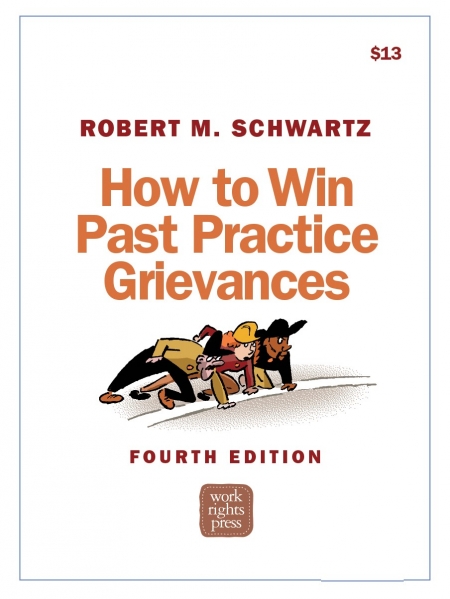
HOW TO WIN PAST PRACTICE GRIEVANCES
STRIKES, PICKETING AND INSIDE CAMPAIGNS
THE LEGAL RIGHTS OF UNION STEWARDS
THE FMLA HANDBOOK
THE LABOR LAW SOURCE BOOK
WORKERS COMP
ORDER FORM
FREE SEMINAR
CONTACT US
ollective bargaining agreements between unions and employers are more than a series of written articles and sections. Under principles endorsed by the U.S. Supreme Court, union contracts also include implied agreements.
Clarifying practices implement general or ambiguous contract language. A clarifying practice is almost always considered to be a mutual agreement.
Encourage numbers of workers to file grievances on the matter
Distribute leaflets about the dispute
Circulate petitions
Hold meetings during breaks
Picket before or after work or during breaks (being sure not to interfere with employees, suppliers, or shippers)